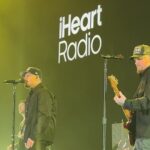
 For a festival built on alternative music’s past, present, and future, Good Charlotte felt like a necessary anchor at the 2026 iHeartRadio ALTer EGO Fest in Los Angeles. At the Kia Forum, surrounded by bands spanning multiple generations, the Madden brothers and company delivered a set that wasn’t about reinvention or subtlety. It was about recognition, release, and the reminder that early-2000s pop-punk, when done right, still hits with unapologetic force.
Good Charlotte walked onstage with the confidence of a band that knows exactly who they are and what the audience wants. There was no pretense, no attempt to modernize their sound or downplay their legacy. From the first moments, it was clear that this set was designed to trigger muscle memory — the kind that sends thousands of people back to burned CDs, Warped Tour parking lots, and teenage bedrooms plastered with band posters.
They opened with “The Anthem,” and the reaction was immediate and overwhelming. The opening riff barely had time to settle before the crowd took over, singing every word as if it were still 2002. The song hasn’t aged into nostalgia so much as it has solidified into a statement. Live, it remains confrontational, defiant, and perfectly suited for a festival environment where collective shouting feels cathartic rather than chaotic. Joel Madden didn’t need to hype the crowd; the crowd arrived already primed.
Without letting the energy dip, the band launched into “Girls & Boys.” The shift in tone was seamless. Where “The Anthem” is rebellious and raw, “Girls & Boys” leans into satire and swagger. The crowd responded accordingly, trading fists in the air for bouncing movement and knowing smiles. The song’s playful cynicism landed cleanly, and the band leaned into its absurdity without irony, embracing the fact that this song remains one of their most recognizable hooks.
The momentum continued with “Rejects,” a deeper cut that nonetheless felt perfectly placed. Rather than catering exclusively to casual fans, Good Charlotte used this moment to reward longtime listeners. “Rejects” brought a grittier edge to the set, reminding the audience that the band’s appeal was never just about radio hits. There was a rawness to this performance that contrasted nicely with the polish of the previous songs, grounding the set in the band’s punk roots.
Midway through the performance, “The River” marked a tonal shift. Featuring its now-iconic back-and-forth vocal structure, the song carried a darker, more introspective energy. Live, it felt heavier than its studio counterpart, bolstered by the crowd’s call-and-response participation. The song’s themes of temptation and consequence resonated strongly, especially in a room full of adults who grew up with the band and have lived enough life to understand what those lyrics were pointing toward all along.
As the set moved forward, “Dance Floor Anthem” injected a burst of chaotic joy into the night. This was the moment where restraint was fully abandoned. The floor bounced. People jumped, screamed, and lost whatever composure they had been pretending to maintain. The song’s bratty energy translated perfectly to the festival stage, serving as a reminder that Good Charlotte’s strength has always been their ability to turn frustration into fun without dulling either.
The band closed with “Lifestyles of the Rich & Famous,” and it felt less like a finale and more like a victory lap. The song’s biting critique of celebrity culture remains oddly timeless, and in the context of a massive, industry-backed festival, its message landed with a renewed sense of irony. Joel Madden delivered the lyrics with sharp precision, leaning into the crowd’s energy rather than overpowering it. The chorus echoed through the Kia Forum, loud enough to blur the line between band and audience.
Setlist
The Anthem
Girls & Boys
Rejects
The River
Dance Floor Anthem
Lifestyles of the Rich & Famous
What made Good Charlotte’s performance stand out at ALTer EGO wasn’t just the familiarity of the songs. It was the band’s understanding of their role in the night’s larger narrative. They weren’t trying to prove relevance or chase trends. They trusted the songs, trusted the audience, and allowed the shared history to do the heavy lifting.
There was a noticeable sense of gratitude woven throughout the set. The band acknowledged the crowd not as fans in the abstract, but as people who had grown up alongside them. That mutual recognition created a feedback loop of energy that felt earned rather than manufactured. This wasn’t nostalgia for nostalgia’s sake; it was a reaffirmation of why these songs mattered in the first place.
Musically, the band sounded tight and focused. The guitars were sharp, the rhythm section locked in, and the vocals cut cleanly through the mix. Years away from the constant touring circuit haven’t dulled their performance instincts. If anything, the distance seems to have sharpened their appreciation for moments like this.
In a festival stacked with legacy acts, Good Charlotte’s set was one of the most cohesive and emotionally satisfying. It reminded the audience that pop-punk’s power lies not in technical complexity, but in its ability to articulate anger, insecurity, and ambition in a way that feels communal. At ALTer EGO Fest 2026, Good Charlotte didn’t just revisit their past — they validated it.
By the time the band left the stage, the crowd was still buzzing, voices hoarse and smiles wide. Good Charlotte delivered exactly what the moment called for: a loud, unapologetic reminder that sometimes the simplest songs — shouted together in a crowded room — are the ones that last the longest.